JEAN-VINCENT SIMONET
Deep peeling
info
back
close
back
JEAN-VINCENT SIMONET
Deep peeling
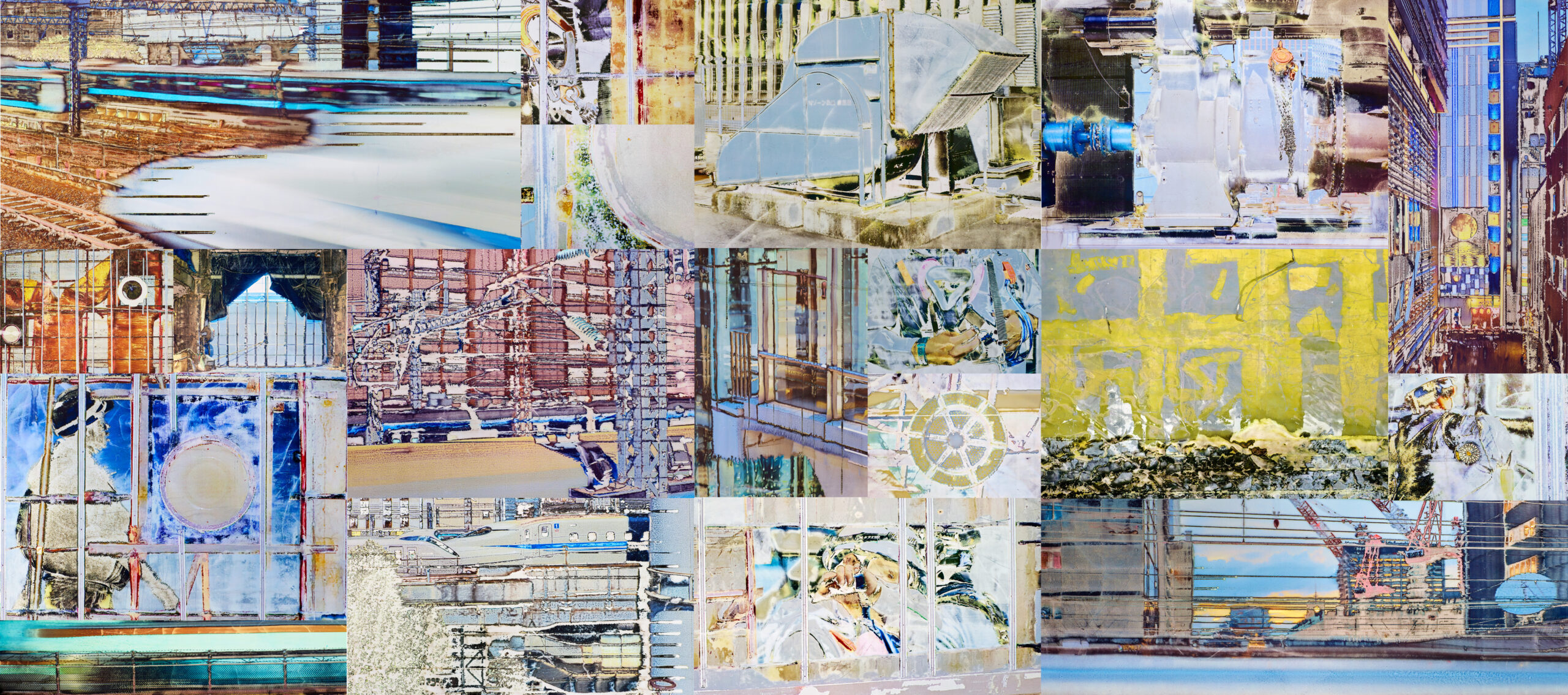
This installation was created in Yurakucho during the YAU Exchange residency, working inside two buildings in the process of demolition and along a segment of the closed KK Line highway. These sites were chosen because they embody the raw condition of transition, caught between dismantling and reconstruction. Tokyo is a city in constant mutation, and Yurakucho exemplifies this restless state: a district where commerce, transport, and entertainment are continuously reconfigured, and where entire blocks dissolve and reform into new centers with relentless speed.
I wanted the work to embody that instability. My process transforms photographs into mutable material. Surfaces that peel, liquefy, and distort until they stop operating as representations and begin to behave like the city itself: provisional, fragile, always in motion. The goal was not to capture a frozen moment in Yurakucho’s redevelopment, but to push the images into the same accelerated tempo that governs the city.
This approach resonates with Deleuze’s idea of the fold: a surface that never flattens but bends, twists, and contains both inside and outside at once. In Tokyo, the urban fabric feels like such a fold, not a fixed structure, but a restless surface collapsing and expanding in the same gesture. Working on these images, I wanted to give form to that sensation: the city as an unending fold.
The resulting fresque is built from infrastructural fragments: ducts, scaffolds, cranes, railways, shards of reflective glass. They are not grand or monumental images, but details in flux, often overlooked in the daily rush. The presence of workers, constantly dismantling and rebuilding, anchors the fresque in lived labor, making visible the human scale behind the machinery of change.
I have long been interested in how photography can be destabilized, how it can move away from serving as a record of reality to becoming a matter in transformation. By subjecting the images to processes of liquefaction and erosion, I let them behave like the environments they describe. The photograph ceases to be evidence and becomes an event, a surface exposed to mutation.
Yurakucho is both a site and a condition: a node in Tokyo’s metabolism, defined by acceleration, erasure, and regeneration. This installation responds directly to that rhythm, unfolding as a fresque of unstable surfaces where architecture and photography converge, tracing the velocity of a city that persists only through transformation.
profile
JEAN-VINCENT SIMONET
Artist. Jean-Vincent Simonet (b. 1991, Bourgoin-Jallieu, FR) graduated from the École Cantonale d’Art de Lausanne (ECAL) in 2014 and now splits his time between Paris and Zurich. Simonet developed a practice that fuses traditional photographic techniques with experimental printmaking processes. Influenced by his upbringing in a family of industrial printers, he merges digital precision with tactile interventions. Faced with the flood, the abundance but also the disembodiment of images in the 21st century, he aspires to revive their aura and their physicality.
Simonet has exhibited at institutions and galleries, including the Centre de la Photographie (Geneva), Sentiment (Zurich), Fotomuseum (Winterthur), FOAM (Amsterdam), Webber Gallery (London), The Ravestijn Gallery (Amsterdam), Paris Photo’s Curiosa and main sector, CentroCentro (Madrid), Salon Approche (Paris), Cabaret Voltaire (Zurich), and the Centre Photographique de Rouen. His works are part of various private and public collections, such as the Vontobel Art Collection, the Musée de l’Elysée (Lausanne), FOAM (Amsterdam), Swiss Post, the Mirabaud Foundation, and the LUMA Foundation.